What Exactly Does “Rescoping” Mean? Considerations for DOE Awards Currently Addressing Requests to Modify
By Keith Boyea, OCED alum; Gabe Daly, GC Alum; Mari Quenemoen, L4GG Staff Attorney; and Tarak Shah, S1/S4 Alum

On April 14, 2026, the U.S. Department of Energy (DOE) told Congress that it had reviewed a portfolio of 2,271 projects and intends to retain or modify 1,951 of them. In some cases, DOE has already requested that projects modify– or “rescope” in DOE’s terminology– their awards to better align with the administration’s priorities. For example, this might mean eliminating work on community benefit plans, references to diversity, equity, and inclusion (DEI), or cutting project work on solar power. In addition, over 300 DOE projects that were previously terminated remain terminated, and many are awaiting a DOE response to their termination dispute letters. As part of the informal dispute resolution process and the formal appeals process, DOE might offer to reinstate projects with changes in project scope as well.
As DOE asks retained and reinstated projects to rescope, many questions remain unanswered, including how much the Department can change a project before it violates the statute underlying the award or DOE’s own internal guidance on project revisions. This article explores some of the considerations both DOE and its awardees should weigh when rescoping a project.
Project Changes Are Normal
Almost all DOE projects request and receive modifications during their lifecycle - that’s normal. Some modifications are administrative. For example, a formal modification is necessary when DOE changes the Technical Project Officer. Many, however, are more substantive. Projects can change substantively for many legitimate reasons, including but not limited to:
Normal project maturation. When projects are first proposed, they are often just ideas on paper. When those ideas meet reality, they often change. DOE typically accommodates such changes, within reason and to the extent consistent with the law.
Technology doesn’t advance as expected. Projects often encounter technology that works differently than it did in the lab or at pilot scale. Here, changes to the technology itself or a return to the lab may be in order.
Economic issues. Sometimes projects require changes due to economic circumstances. For example, the price of natural gas can affect the cost competitiveness of nuclear energy which, in turn, affects the ability of project developers to obtain financing. Inflation can also impact project costs and financing.
NEPA, permitting, and interconnection. Compliance with the National Environmental Policy Act (NEPA) and other permitting requirements, and particularly litigation challenging them, can delay projects and increase costs, both of which may require project modifications.
Sometimes these “normal” changes can result in the project looking substantially different than it looked at the outset. Almost all of them are “event driven,” meaning they respond to actual issues that arise during performance, and they are typically requested by the awardee. The difference in the current case is that these project changes are being requested by the Department and driven by “changing agency priorities.” There is much less precedent for such changes.
Congress Has Enacted Limits
When considering changes to an award, the first step in the analysis is to review the Congressional authorization and appropriation language that funds the program under which the award was issued. Both the authorization and the appropriation limit DOE’s discretion: DOE may only award funds consistent with both limits. Under the “Purpose Statute” (31 USC 1301), funds are available only for the purpose for which Congress appropriated them. DOE’s violation of the Purpose Statute can lead to an Anti-Deficiency Act violation, for which there are potential administrative and criminal penalties including a federal employee’s dismissal, fines and jail time. It is well established administrative law that an agency cannot act at all without authorization.
As DOE alum Danielle Lemmon wrote in an op-ed in The Hill earlier this year, DOE is in at least one instance attempting to use appropriated funds contrary to the purpose that Congress intended. Specifically, DOE has solicited applications for funding to recommission coal power plants, even though Congress appropriated the relevant funds to commercialize carbon capture technologies. In February, senior members of the Senate energy appropriations and authorizing committees wrote to DOE to share their concerns, writing that “the Department must faithfully execute the law and expend the funds for the purposes provided.”
As another example, in 2023, DOE made a $500 million award under Inflation Reduction Act (IRA) Section 50161 to Cleveland-Cliffs, a steel manufacturer in Middletown, Ohio, through the Industrial Demonstrations Program (IDP). The IDP is a $6.3 billion effort that demonstrates the technical and commercial viability of first- or early-of-a- kind commercial-scale industrial decarbonization approaches in the iron and steel, cement and concrete, chemicals and refining, food and beverage, paper and forest products, aluminum, other energy-intensive manufacturing industries and cross-cutting technologies.
When the Cleveland-Cliffs IDP project was awarded, it was intended to decarbonize the automotive industry’s supply chain by demonstrating hydrogen-based iron making technology, and bring down carbon emissions by one million tons per year, while also nearly eliminating carbon monoxide, sulfur dioxide, and volatile organic compound pollution, and substantially reducing particulate matter and nitrous oxide pollution. Last May, Cleveland-Cliffs announced that it was abandoning the project in favor of relining an existing blast furnace, a move that will lock in 15-18 more years of coal use, per its air permit application.
However, earlier this month, DOE announced that it is keeping the project on its list of awards to retain and has declined to answer rumors about whether the IDP funds will be used to fund the blast furnace relining. Section 50161 requires that funds be spent “to accelerate greenhouse gas emissions reduction progress to net-zero at an eligible facility.” Simply relining an existing blast furnace does not accomplish this requirement and it is hard to see how it wouldn’t be a clear violation of the IRA and the Purpose Statute to use funds appropriated under Section 50161 to do so.
In some cases, the statutory provisions authorizing a program are very specific. Consider the appropriation language for the DOE Hydrogen Hubs in Section 40314 of the 2021 Infrastructure Investment and Jobs Act (IIJA):
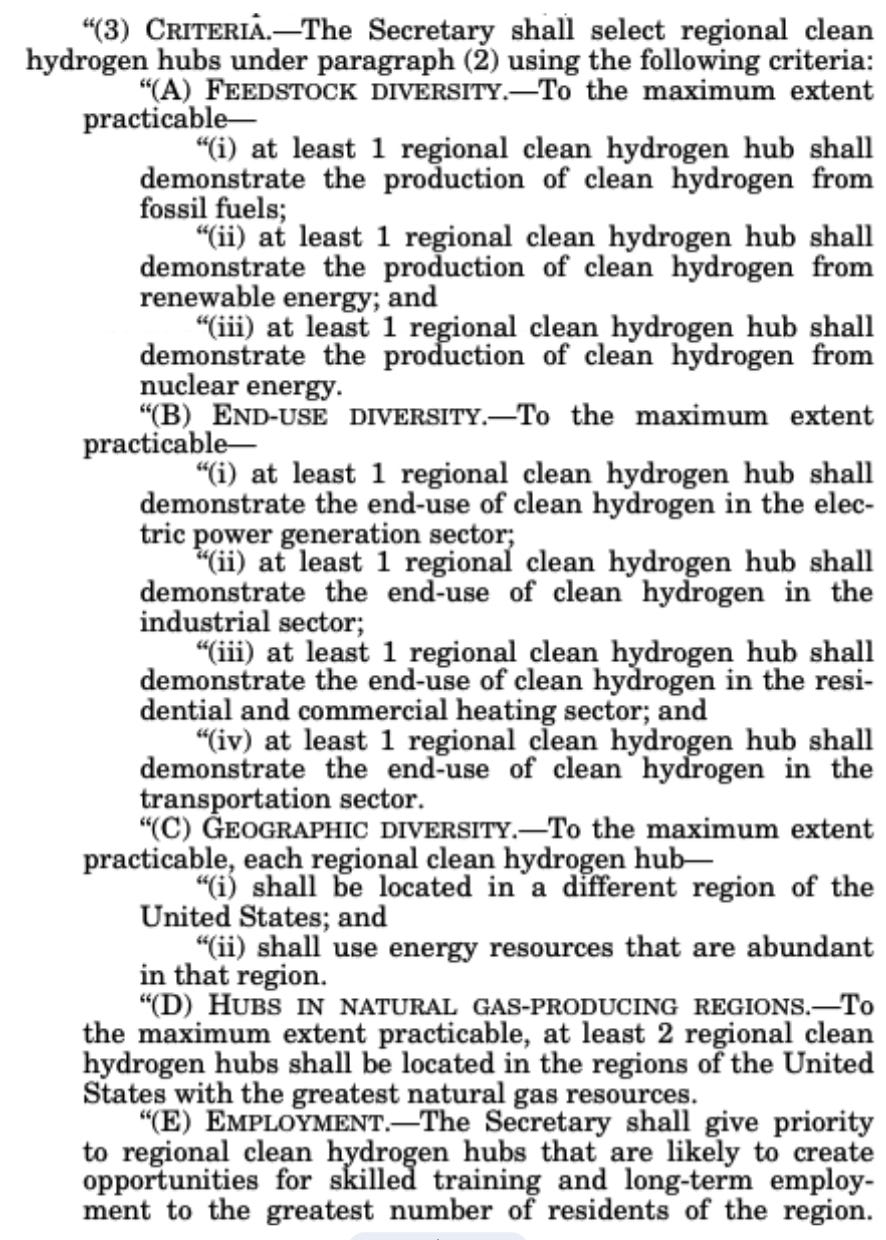
Based on the law, DOE is constrained in what it must fund: at least one regional “Hub” must demonstrate the production of clean hydrogen from renewable energy (so-called “green hydrogen”); one hub must demonstrate hydrogen production from nuclear energy (“pink” hydrogen). DOE has discretion over many aspects of the Hubs–their location, their offtakers, etc.--but Congress mandated that the program fund certain kinds of projects (IIJA appropriated $8 billion for this purpose). DOE would violate IIJA and the Purpose Statute if it refused to fund green or pink hydrogen projects.
DOE Has Internal Guidance
DOE’s internal guidance on financial assistance matters further limits the agency’s discretion to rescope an award. In the “DOE Guide to Financial Assistance,” DOE states:
“Project revisions or amendments in awards from a competitive announcement must remain within the programmatic boundaries of the announcement and must be considered meritorious under the merit review criteria of the announcement. Substantial changes to the project’s budget and/or scope or objectives will require a determination of non-competitive financial assistance (DNFA) if the changes would not be acceptable under the original NOFO.”
Thus, beyond the limits imposed by the relevant authorizing statute and appropriation, DOE has limited potential scope changes to DOE awards based on the original funding opportunity announcement (FOA). For example, IIJA Section 41007(b)(1) provided $60 million to optimize the performance and operation of wind energy systems. DOE sought applications for that funding under DE-FOA-0002828. This FOA seeks applications in four specific topic areas, and includes a list of topics that were specifically not of interest, including, for example, high voltage DC hardware designs for distributed wind systems. If DOE were to seek to modify a project funded under this FOA to pursue topics that were outside of the original funding opportunity, like high voltage DC hardware designs for distributed wind, it would be contrary to DOE’s Guide.
The guide also limits DOE to making changes that would have been “considered meritorious under the merit review criteria of the announcement.” FOA applications are judged by merit selection panels of career officials, with review criteria published in the FOA in advance of applications being received. If, for example, the FOA states that applications will be judged significantly on the market transformation potential of the technology, DOE could likely not modify a selected workplan to significantly weaken the market transformation potential of the project technology entirely, such that with those changes, the project would likely not have been selected under the FOA. Interpreting this guidance may be complex. Merit review panels don’t typically reconvene after they have made selection decisions, so being able to determine what would be considered meritorious under the original announcement could be challenging. Nevertheless, DOE should be working in good faith to adhere to its own guidance.
Finally, the guide states that substantial changes to the budget or scope would require a project to be reclassified as a determination of non-competitive financial assistance (DNFA). According to the guide, and in accordance with 31 USC 6301, it is DOE’s policy to “use competition in the award of grants and cooperative agreements to the maximum extent feasible.” In other words, because rescoping a project substantially may trigger the need to designate it as a non-competitively selected project, these types of major modifications are not encouraged. If DOE does pursue a DNFA, it would require high level approval from inside DOE and would also require a 30-day Congressional notification called a “301 notice.”
Congress recently directed DOE to follow its own published guidance, including the Guide to Financial Assistance, on page 42 of the report language associated with the Fiscal Year 2026 Appropriation, directing that:
“The Department shall not terminate a federal award in part or its entirety or require a renegotiation or rescoping of a federal award on the basis that the federal award no longer effectuates program goals or agency priorities, including pursuant to section 200.340(a)(4) of title 2, Code of Federal Regulations, without following the Department’s published procedures.”
How It Works Inside
Grantees should also keep in mind the practical and political machinations operating inside the agency during the rescoping process. When the program office team wants to make a change to an existing grant program, they usually approach the contracting officer to initiate the modification. The contracting officer may ask a DOE attorney to review the proposed modification, including to ensure that it complies with the authorizing statute, the Purpose Statute and the DOE Guide to Financial Assistance. All of the parties involved–the program officials, the contracting officer, and the attorney are bound to follow the direction of leadership, while staying within the bounds of the law and regulations.
Anticipating that such a modification may take time, No Cost Time Extensions (NCTE) may allow for continued work under the existing approved scope of work during negotiations and thus minimize project disruptions.
If an awardee feels they are being asked to make changes that are beyond the law or DOE guidance, they may want to share this with their project team and explain why. Recipients should be an active participant in any conversation about scope. In addition, DOE grantees with further questions can sign up for the Lawyers for Good Government Fund Protection Clinic which offers legal assistance to organizations whose federal funding is at risk due to executive actions, administrative delays, termination notices, or compliance challenges.
It’s worth noting that while project changes are a routine part of DOE business, rescoping almost 2,000 projects all at once is not. Once a change is authorized by DOE, DOE still has to negotiate the change with the awardee. New budget submissions trigger a review for allowability, allocability, and reasonableness, and all changes in scope must submit to a “technical evaluation,” and could trigger new audit and reporting requirements. Negotiating changes with the recipient and within the agency on any given project can take months; negotiating 2,000 project changes could take far longer. This is a tall order for a Department that saw 3,000 employees leave under the Deferred Resignation Program last year.
###
This piece was drafted by trusted and vetted alumni of the U.S. Department of Energy. Any views and opinions expressed are that of the author(s) and do not reflect those of the DOE Alumni Network.